Patient portal

“Understanding the natural history of my daughter’s condition has enabled us to anticipate and prevent complications”

The mother of a girl with the metabolic disorder GNAO1, who has taken part in a study alongside children from all over the world, explains how it has benefited her.
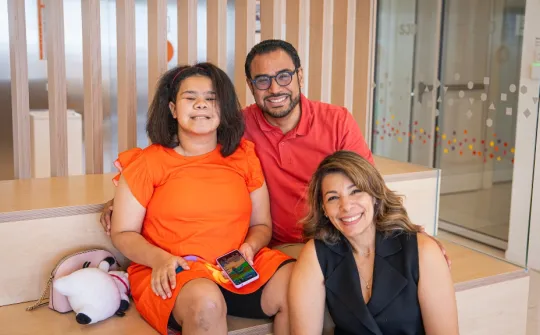
María has GNAO1-associated epileptic and developmental encephalopathy. This is a rare condition that was first identified in 2013, the very year she was born and just a few months before she began showing the first symptoms. However, the little girl’s parents did not know that this was the condition their daughter was suffering from until four years later, in 2017, when, after a journey through various centres, she was referred to SJD Barcelona Children's Hospital and underwent genetic testing.
“For us, the best thing about the diagnosis was that we would no longer have to subject María to further tests, which were often very invasive. We would have loved there to be a cure for her condition, but the truth is we didn’t hold out much hope,” recalls her mother. “Having a diagnosis,” she adds, “also meant we had a specialist in this condition to talk to; someone who understood what we were saying and who guided us. That helped us enormously and continues to help us.”
Participant in a study on the natural history of GNAO1
Having a diagnosis has opened the door for this 12-year-old girl from Segovia to take part in research into her condition. Specifically, she has been one of 63 children from around the world who have taken part over the last three years in a study to understand the natural history of GNAO1-associated epileptic and developmental encephalopathy: at what age the first symptoms appear, what symptoms characterise it, how it progresses...
This is the first study of its kind carried out in Europe and has been led by the Movement Disorders Unit of the Neurology Department at SJD Hospital; the Hospital’s Rehabilitation and Physical Medicine Department; and the paediatric epilepsy and movement disorders research group at the Sant Joan de Déu Research Institute.
The study has revealed that GNAO1 is not a degenerative disease. “But it is progressive,” María’s mother points out. “I used to sense that, when she fell ill, she suffered a setback, and then she didn’t regain the abilities she’d lost. Now it has been proven that this is the case,” she explains.
The study also reveals that patients with the mildest form of the condition improve progressively, whilst those with the most severe form experience a worsening of their movement disorders.
“The study has taught us that affected children do not progress in the same way and that we cannot expect the same from them. The disease has affected María greatly. Knowing that improvement in these cases is limited helps us cope better with the situation and not lose hope. Before, for example, we used to do very intensive physiotherapy with María all year round. Now we’ve reduced the sessions because we know that too much can be harmful for her,” she explains.
For this girl’s mother, the study’s greatest contribution is that it allows us to anticipate and prevent complications. “The professionals have had the opportunity to conduct very comprehensive questionnaires with a large number of families and examine many affected children; they have been able to analyse all the information and now have a more comprehensive picture of the condition. They know that these children may develop, for example, intestinal problems, and they advise the families of children who haven’t had them to be very vigilant for certain signs to avoid them,” she concludes.
Related news