Patient portal


"It took us six years to find a multidisciplinary hospital to treat Maya’s congenital lymphatic malformation"
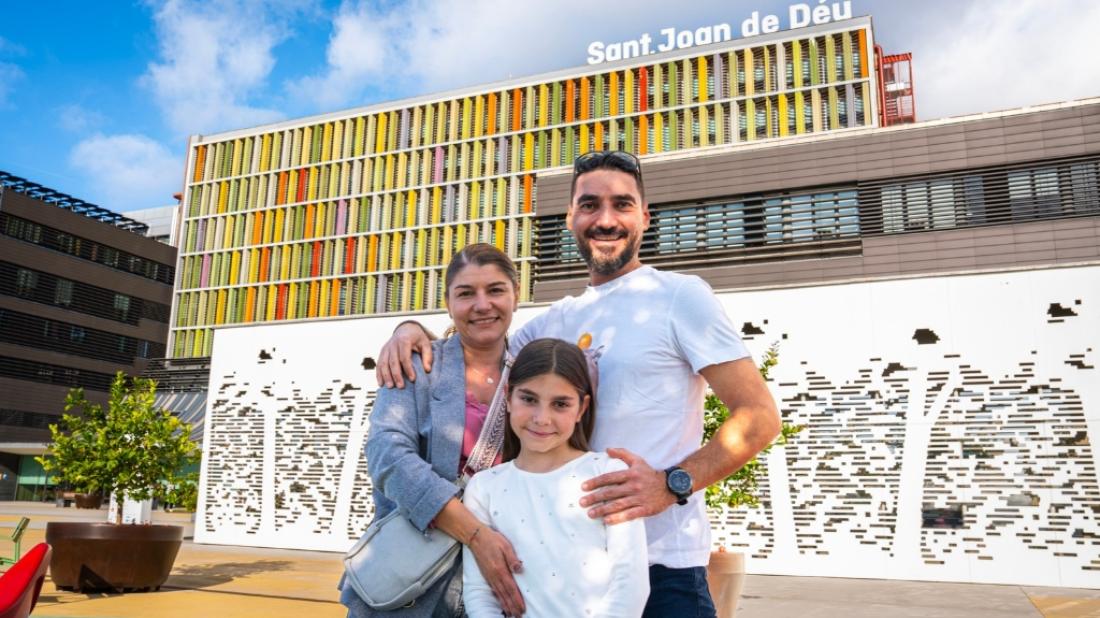
At the SJD Barcelona, Maya, a nine-year-old girl from Romania, has been assessed by specialists from 14 different fields to treat her for an ultra-rare condition involving congenital lymphatic malformation of the bones.
When Maya was one and a half years old, her parents noticed a small lump in her groin area. Months later, they realised that her right leg was growing faster than her left. After numerous medical consultations in Romania, she was diagnosed with congenital lymphatic malformation (GLA), a rare condition for which no clear treatment was available in her country.
The family consulted specialists and hospitals in various European countries (Paris, Berlin, Budapest, Madrid, Zurich…), as well as leading centres in the United States. However, they continued to receive piecemeal proposals for tackling a condition that required a coordinated assessment by different specialists.
The situation became even more complicated when Maya suffered a fractured femur. Due to the complexity of her condition, the family could not find a team with sufficient experience to carry out the operation.
It was then that they sought a second opinion from SJD Barcelona Children’s Hospital. Within a few days, they received a detailed assessment and a care plan coordinated by a multidisciplinary team. That response was the decisive factor in the family’s decision to travel to Barcelona.
A comprehensive treatment approach
On her arrival at the hospital, Maya was assessed by specialists from 14 different disciplines, including haematology, neurology, orthopaedics, rheumatology, rehabilitation, dermatology and oncology. This joint assessment made it possible to analyse how the condition was affecting her as a whole and to determine the most appropriate treatment.
Dr Eulàlia Baselga, Head of the Dermatology Department at SJD Barcelona, explains: “Maya’s condition is highly complex and required a great deal of coordination amongst all the experts. At SJD, we have extensive experience in treating lymphatic malformations and we are the only Spanish centre that forms part of the European Reference Network (ERN VASCERN-VASCA) for vascular anomalies.”
Her mother recalls that the treatment approach was particularly complex. Before the femur surgery, it was necessary to manage the malformation with treatment to reduce the risk of complications and infections associated with the lymphatic condition.
Dr Verónica Celis, a haematologist and oncologist at SJD Barcelona, explains that “Maya was treated with sirolimus (rapamycin), an oral targeted therapy that acts on specific mechanisms of the disease, which made it possible to control the lymphatic malformation, reduce complications and prepare the girl for complex surgery. Her favourable outcome highlights the value of a multidisciplinary and personalised approach to rare diseases.”
The hospital’s Orthopaedics team, led by Dr César García Fontecha, planned reconstructive surgery on a femur with a complex deformity, against a background of severe lymphatic abnormalities and significant fragility. The femur surgery was carried out in February 2026 and the outcome was very favourable. A few weeks later, Maya gradually regained her mobility.
“Today her leg is straight again. She can run, dance and play sport just like any other girl her age, and her lymphatic condition is better controlled,” explains her mother.
Although her recovery has been positive, Maya continues to be monitored with regular check-ups, as the affected leg is three centimetres shorter and its growth pattern remains different from that of the healthy limb.
“For years we searched for answers in different countries without finding a team that could tackle the condition holistically. Here we have found professionals who work together and truly understand the complexity of Maya’s case. That gives us peace of mind as we look to the future,” the family emphasises.
Maya’s family’s experience at SJD
Beyond the medical treatment, the family highlights the care they received during their stay in Barcelona. In fact, when Maya was discharged after her operation, she didn’t want to leave the hospital.
Her mother says that the human touch has been just as important as the medical care: “Here we’ve found a team that’s highly professional and, at the same time, very warm and approachable. When you’re working with children, something as simple as being greeted with a smile makes a huge difference.”
The family say that this coordination and the support they received from Anna Malomuzh, the ‘patient manager’, was one of the key differences compared to other centres they had visited previously, and one of the reasons why they continue to entrust Maya’s follow-up care to the SJD team.
Related news