Patient portal


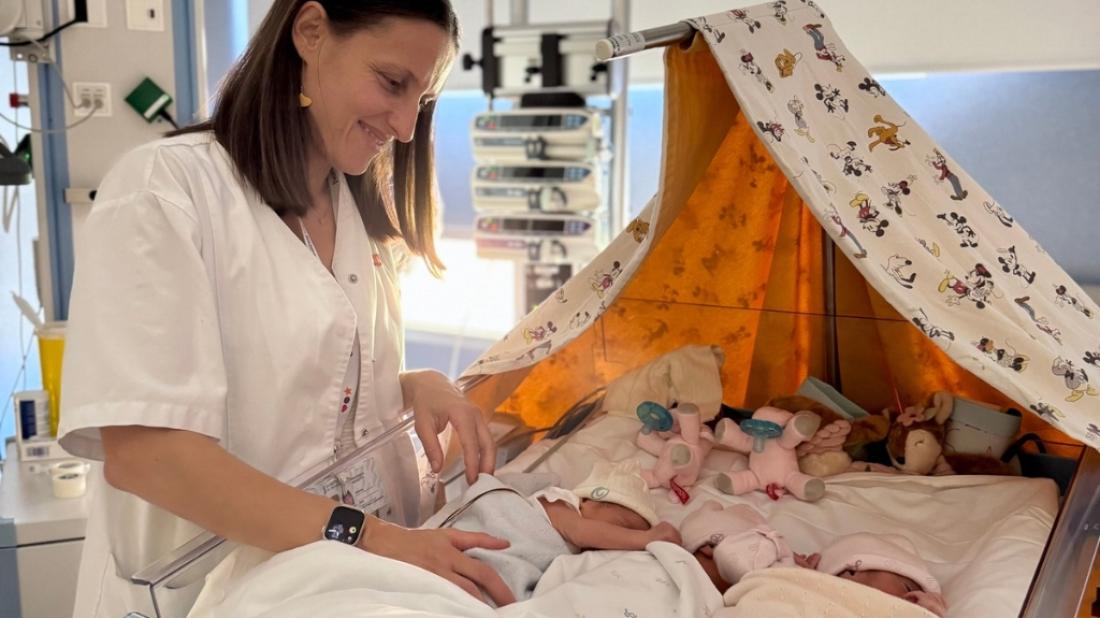
The Fetal Medicine team offers specialist care to detect complications during pregnancy and prepare for the birth, prioritising the health of the mother and babies.
A triplet pregnancy is always a challenge, both for the mother and her babies and for the healthcare professionals who will be looking after them. In such cases, it is not simply a matter of monitoring the development of more than one foetus; there are also many associated risks that must be taken into account. SJD Barcelona Children's Hospital is a tertiary care centre with specialists in obstetrics and neonatology, equipped to provide the detailed monitoring required for triplet pregnancies.
Dr Francesca Crovetto, a specialist in maternal-foetal medicine at SJD Barcelona, highlights – following a recent successful case involving triplets at the hospital – three key aspects to bear in mind when monitoring these pregnancies: prematurity, possible differences in foetal growth, and risks to the mother’s health.
Preventing preterm birth
The risk of preterm birth is one of the main complications of multiple pregnancies, particularly when three or more foetuses are expected. For example, around 75 per cent of spontaneous triplet pregnancies go into labour before 35 weeks’ gestation, and almost 50 per cent are delivered before 32 weeks.
To prevent this complication and attempt to manage it, the medical team closely monitors the pregnancy and checks, amongst other things, the length of the cervix. In triplet pregnancies, the mother’s uterus is subjected to greater stretching, which increases the risk of premature contractions and, consequently, could lead to early labour.
In this case, the main recommendation is bed rest. However, Crovetto notes: “There are occasions when the patient may show signs of risk that require more comprehensive care; in such cases, she is admitted to hospital and we follow the protocol for threatened preterm labour.”
SJD Barcelona Children's Hospital offers a antenatal preparation programme for families expecting a premature baby, such as those expecting triplets. Through a series of visits to the hospital, expectant parents can familiarise themselves with the Neonatology Department, its facilities and the healthcare team. In addition, the programme includes a simulation session that recreates the hospital environment, complete with an incubator, monitors and a manikin, which helps to reduce uncertainty and enables parents to approach the birth with greater emotional confidence.
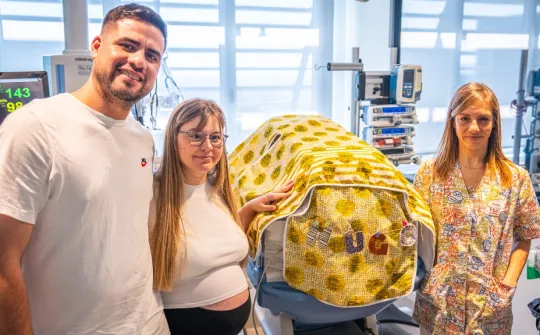
Monitoring foetal growth
Another important aspect is to check that all the foetuses are growing properly. Although it is common for there to be differences in size between the babies in a triplet pregnancy, significant discrepancies may indicate that one is not growing as expected. “The difference in size between the foetuses should not exceed 25 or 30 per cent in a normal situation,” says Crovetto.
In this regard, the doctor explains that it is very important to determine in the first trimester how many placentas and how many amniotic sacs there are in each triplet pregnancy. “It may be that each foetus has its own, or that two are together and the other is separate. This situation can lead to a wide variation in complications,” she explains. For this reason, ultrasound scans enable the growth of each foetus to be monitored and any potential abnormalities identified that may require more frequent monitoring.
Care for the mother
A triplet pregnancy also carries risks for the mother: there is a higher likelihood of complications such as pre-eclampsia, a condition associated with high blood pressure during pregnancy, or anaemia. It may also increase the risk of postpartum haemorrhage, due to the greater stretching of the uterus.
At SJD Barcelona Children's Hospital, specialists in maternal-foetal medicine have units equipped to manage multiple pregnancies – such as triplets – premature babies, foetal growth problems and pre-eclampsia, enabling them to tailor care to the needs of each pregnancy. The team therefore plans for the babies’ birth, taking into account the progress of each pregnancy, and prepares the necessary resources to care for the babies, who may require specialised care.
The Neonatal Intensive Care Unit at SJD Barcelona treats around 600 newborns each year who require admission, many of them due to prematurity. Care also extends to families, with spaces provided for them to spend time with their baby and to encourage skin-to-skin contact, the ‘kangaroo care’ method and other forms of care. At the hospital, the approach to multiple pregnancies does not end with the birth, but continues with the aim of improving the health and development of each newborn.
Related news