
 Patient portal

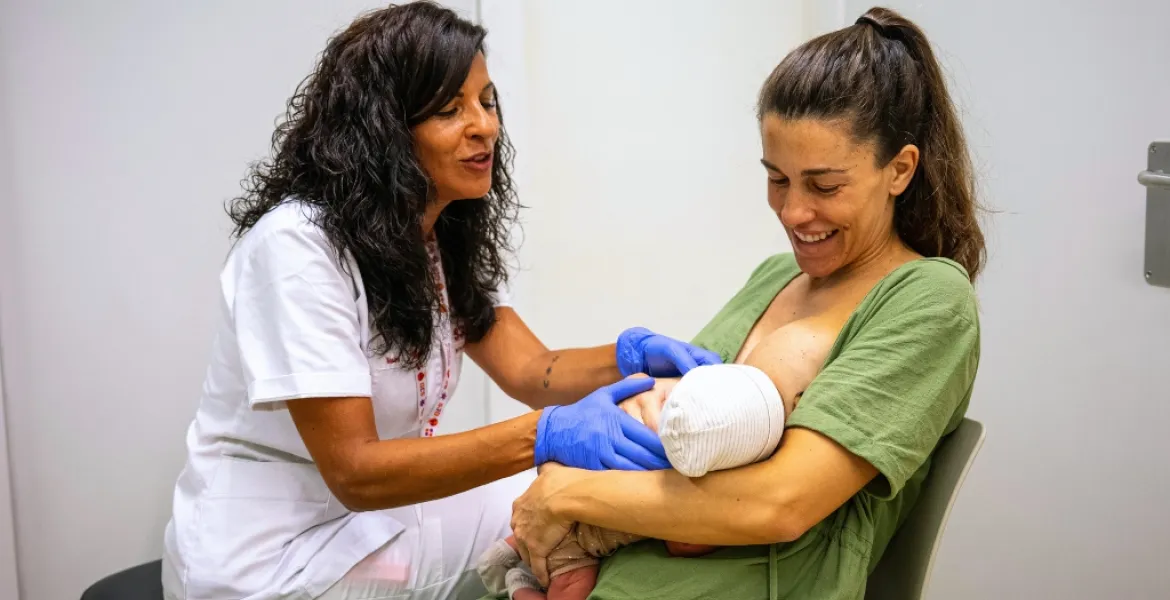
The first few hours and days after giving birth are intense and full of joy, but they can also be exhausting and challenging. Our midwives and nurses will be there to support you during this time and answer any questions you may have about breastfeeding and looking after your baby.
Breastfeeding
During your stay at Sant Joan de Déu Barcelona Hospital, we will help you to start breastfeeding, wherever possible and if you wish to do so.
Although it is a natural process, it is a skill that is learnt. The success of breastfeeding depends on several factors, one of the most important being the correct technique. We will be there to guide you as you learn how to breastfeed your baby.
If you have decided to feed your baby with formula, or find yourself in a situation where you are unable to breastfeed, you should know that you can feed your baby with just as much affection, love and physical contact as you would when breastfeeding.
Everything you need to know about breastfeeding
The Women’s Department at Sant Joan de Déu Hospital has put together this information pack on breastfeeding. You’ll find information on breastfeeding techniques, frequently asked questions, formula feeding and a video of a webinar presented by our midwives.

Discharge from hospital
The timing of your discharge from hospital will depend on both your clinical progress and that of your baby.
To help you adjust to this new stage in your life, we encourage early discharge whenever circumstances allow. Your stay in hospital may therefore vary between 12 and 72 hours, depending on whether you had a vaginal birth or not, and whether this required instrumental assistance or a caesarean section, as well as other factors.
The healthcare team, comprising both obstetrics and paediatrics staff, will assess how long you and your baby will need to stay in hospital, based on the nature of the birth and your health.
Once it has been confirmed that the mother’s postnatal recovery is progressing well and the newborn is adapting well, you will be discharged and will be able to continue all your postnatal care at the ASSIR centre (Sexual and Reproductive Health Care) and paediatric check-ups at the Primary Care Centre.
The option of home hospitalisation
Sant Joan de Déu Barcelona Hospital can offer the option of transferring hospital care to the home for those mothers who wish to do so and who meet the inclusion criteria for the HDOM (Home Hospitalisation) programme. The aim is to improve the quality of the entire process, ensuring safety for both you and your baby, whilst offering the comfort of being at home.
Provided there are no contraindications, the programme involves facilitating the transfer of the mother and baby home 12 hours after the birth, followed by a face-to-face visit from a midwife at your home 24–48 hours after the birth. During this visit, the midwife will carry out a clinical assessment of the mother and baby and perform transcutaneous bilirubin tests, as well as screening for congenital neonatal conditions and hearing problems, if these have not already been carried out during your stay in hospital.
This is a home-based care programme, during which you can contact us by telephone to clarify any queries or seek advice.
Once the midwife has confirmed that your postnatal recovery is progressing normally and that your baby has settled in well, she will discharge you, and you will need to contact your Primary Care Centre and the ASSIR centre to arrange follow-up check-ups.
Postnatal period or puerperium
The postnatal period, also known as the puerperium or the ‘40 days’, is the period that begins after the baby is born and lasts for approximately 40 days. During this time, the mother’s body recovers and gradually returns to its pre-pregnancy state.
Breastfeeding begins during the postnatal period and, later on, ovulation and menstruation may resume. Although it is a time full of joy and excitement, it can also be a demanding period, particularly for the mother.
Issues that may arise during the postpartum period:
- Extreme tiredness.
- Lack of sleep.
- Body aches.
- Stress.
- Difficulties with breastfeeding.
- Reduced sex drive.
- Urinary incontinence.
All of this forms part of what is often called the ‘fourth trimester’, a period of major physical and emotional changes that requires care, support and time.
Postnatal care at home
This stage lasts approximately 40 days or six weeks. It is commonly known as ‘confinement’. Below, we outline a few things to bear in mind once you get home.
Vaginal bleeding
Vaginal bleeding will gradually decrease. It is important to follow the advice to use only sanitary pads – not tampons or menstrual cups. It is also not recommended to have penetrative sex or to bathe in a bath, swimming pool or at the beach. Showering is recommended for daily hygiene.
Wound care
Caring for caesarean section, episiotomy or perineal tear wounds at home is not particularly difficult. The most important thing is to wash them with water and mild soap at least once a day, and then dry them thoroughly.
However, there are some warning signs that may mean you should contact your GP practice:
- Heavy or foul-smelling bleeding that persists for several days.
- A temperature above 38 degrees.
- Abdominal or perineal pain that is not relieved by standard painkillers.
- Discomfort when urinating (burning sensation, inability to urinate).
- Pain and swelling in the legs.
- Inability to empty one of the breasts, accompanied by a rise in local temperature and redness of the skin.
- A change in mood that affects your relationship with your baby or with other people and impacts your quality of life.
- Infection of the caesarean section or perineal wound, with the appearance of discharge and redness.
- Headache, particularly if accompanied by visual disturbances, nausea or vomiting.
Pain
Pain can interfere with your ability to look after yourself and your baby, so it is very important to manage it. There are currently various ways to relieve pain, with or without medication. It is recommended that you start with simple measures, such as walking, applying heat or cold to the area, massaging your uterus or breasts, or alternating between hot and cold showers.
If this is not enough, there are also medicines that are safe to take, even if you are breastfeeding, such as paracetamol or anti-inflammatories. Consult your healthcare professional so they can advise you on which is most suitable for you.
Examples of causes of pain and relief options
Pain is considered mild and uncomplicated when it subsides with the following recommendations and continues to improve day by day. However, if you find that these guidelines do not help you or if you even notice a worsening of symptoms, you should consult your healthcare professional or visit your local health centre.
This is usually caused by uterine contractions and is most common in the first few days after giving birth whilst breastfeeding. Try applying heat locally using a hot water bottle; if there is no improvement, ask your doctor whether you can take painkillers or anti-inflammatories.
Perineal tears, episiotomy, caesarean section wound. It is very important to keep the wound clean and dry. The longer you can leave the wound exposed to the air, without any dressing, the faster it will heal. If you’re in pain, you can try applying ice to the area; if the pain persists, ask your healthcare professional whether you can take painkillers or anti-inflammatories.
It is very important to avoid constipation, so you should drink plenty of water and eat a diet rich in fibre (vegetables, fruit). To relieve the pain of haemorrhoids, you can use anaesthetic creams or corticosteroid creams specifically designed for haemorrhoids for short periods.
Alternating between hot and cold showers can help relieve pain and reduce breast engorgement and tenderness. If this does not help, you could try breast massage, applying cabbage leaves and expressing milk (either by hand or with a breast pump). Ask your doctor whether you can take painkillers or anti-inflammatories.
Emotional state
Pregnancy, childbirth and the postnatal period are among the most transformative, complex and vulnerable times in a woman’s life. It is very important to recognise how you are feeling emotionally and to seek professional help if you need it.
If you are experiencing symptoms of sadness and anxiety that worry you or interfere with your daily life, these should be assessed to determine whether they are a temporary state or postnatal depression.
- A temporary state, sometimes known as the ‘maternity blues’: This can last up to two weeks and may include crying, tiredness, insomnia, sadness or feelings of being overwhelmed. These symptoms do not interfere with your daily activities and, clinically speaking, are not considered a serious problem, but they should be monitored as they can develop into postnatal depression.
- Postnatal depression: This generally lasts for more than two weeks and limits your ability to carry out daily activities and look after your baby. It is very important that you receive appropriate medical care to overcome this condition.
Find out more about postnatal depression
Monitoring chronic conditions
Even after giving birth, it is essential to monitor any conditions you may have had during pregnancy. The most important ones requiring specific monitoring during the postnatal period are:
- Hypertensive disorders.
- Obesity.
- Diabetes.
- Thyroid disorders.
- Kidney disease.
- Mood disorders.
Close coordination with the primary care medical team is essential, and the implications for future motherhood and long-term maternal health must be considered.
Healthy lifestyle
For the sake of both your health and that of your son or daughter, it is highly recommended that you adopt healthy habits during this stage and try to ensure that these habits remain with you for the rest of your life.
A varied and balanced diet will help you recover from the physical strain of pregnancy and childbirth. Eat well and drink plenty of water. Try to eat foods rich in fibre to prevent constipation and relieve any haemorrhoids you may have.
One of the most difficult changes after giving birth is the lack of sleep. Mums and dads no longer sleep when they want to, but when they can. For this reason, it is advisable to adapt to the baby’s timetable and, as far as possible, follow their sleep and wake cycle. Sleeping in bed in a calm and relaxed environment helps ensure a more restful sleep, even if it is only for a short time.
Taking care of your personal appearance will help you feel better about yourself, boost your self-esteem and gain confidence. It’s important to get organised and set aside a little time for yourself each day. Dedicating this time to yourself isn’t a luxury – it’s essential for your wellbeing.
In this regard, exercise can be a great ally in helping you recover effectively and safely after giving birth. You can gradually resume exercise after the birth, depending on how it went (vaginal birth or caesarean section). Your doctor or midwife will advise you when you can start, depending on your recovery and whether or not there are any complications. Gentle activities such as going for a walk, doing some stretching or breathing exercises are good options to start with after giving birth.
Furthermore, during this stage it is advisable to resume pelvic floor exercises (Kegel exercises or pelvic muscle contractions).
You can ask your GP practice for more information about these exercises and for them to monitor any potential problems with urinary or faecal incontinence following childbirth.
Donation of breast milk
Breast milk is the best food a baby can have and helps the development of low-birth-weight premature babies (weighing less than 1,500 grams), as well as babies who are at risk of digestive or intestinal disorders or who are born with an immune deficiency. However, there are sometimes mothers who are unable to breastfeed their babies, even though they would like to.
Banked breast milk is given to babies on medical prescription whilst they are unable to be breastfed by their mother.

Sexual relations
It is recommended that you do not resume penetrative sex until the postnatal period is over (six weeks after giving birth) and after a follow-up appointment with your midwife or gynaecologist to confirm that everything is fine.
However, after giving birth you may experience some difficulties when resuming sexual relations, at least during the first three months, although in some cases this may take longer. There are many reasons for this; every couple is different, as are every birth and every personal situation.
In the case of a vaginal birth, if an episiotomy or any tears have occurred, the area is more sensitive due to scar tissue; and if a caesarean section has been performed, physical recovery is usually slower. It is also normal for the vaginal area to be less moist due to a lack of lubrication, particularly if you are breastfeeding, as breastfeeding reduces oestrogen production and, consequently, increases vaginal dryness.
Some women resume their sex life without much difficulty. Others, however, prefer to wait a little longer until their libido returns and they feel more at ease.
Contraceptive methods
For most women, a gap of 18 to 24 months is recommended before trying for another baby. It is particularly important to allow this time if you have had a caesarean section.
Not all methods of contraception are recommended during the postnatal period, so it is important that you receive proper advice on contraception at your ‘postnatal check-up’, if that is your choice.
- Breastfeeding, although it reduces the likelihood of becoming pregnant, is not always an effective method of contraception.
- If you are not breastfeeding, ovarian activity usually resumes 40–60 days after giving birth, so it is advisable to start using contraception again.
Finally, remember that you should resume your regular gynaecological check-ups as you did before your pregnancy.
Caring for your baby at home
The arrival of a newborn at home marks the start of a period of change, during which mums and dads must take on the responsibility of caring for and meeting the needs of your son or daughter. In many cases, this can be a huge challenge. To help you, we’ll briefly explain what you should do in the various everyday situations you’ll face during the first few days of your newborn’s life.
