
 Patient portal

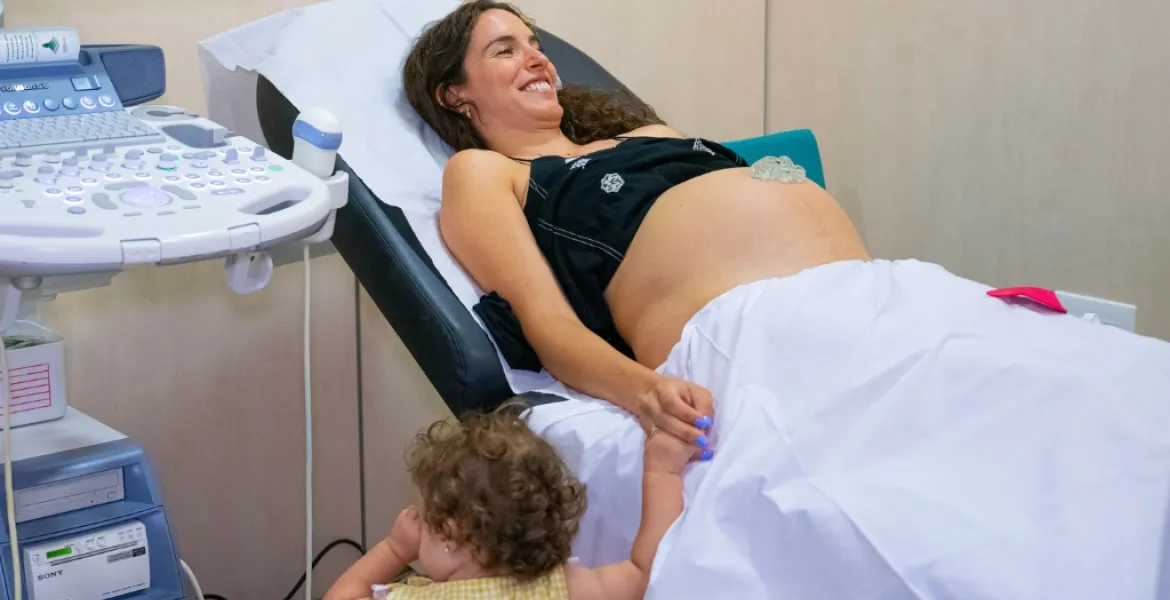
You will have your antenatal care at the primary care centre; only in the case of a high-risk pregnancy will your care take place at a hospital.
During pregnancy, it is important to maintain healthy habits in terms of diet, physical activity and emotional wellbeing. If you need help, please contact your healthcare professional.
For a healthy pregnancy
At Sant Joan de Déu Barcelona Hospital, we’d like to offer you some advice that may be useful during your pregnancy. Please bear in mind, however, that this information is for general guidance only and is not a substitute for the advice of healthcare professionals.
If you need help, please contact your healthcare professional.

Prenatal care at Sant Joan de Déu Hospital, Barcelona
As the time of delivery approaches, your midwife or your designated healthcare professional at the Primary Care Centre (CAP) should refer you to the hospital in week 34 or 35.
If you have been referred to Sant Joan de Déu, you will be given an initial appointment with our team, where you can make arrangements for your birth at our hospital. During this appointment, we will go through your birth plan and provide health advice for the third trimester.
Sant Joan de Déu also holds an online information session to show expectant mothers and their companions how we work, as well as the hospital facilities, the healthcare professionals involved, the usual procedures, etc. During the session, you will be able to ask the midwife leading the session any questions you may have.
If a condition has been diagnosed in the foetus, we arrange a prenatal appointment with the neonatologist and introduce you to both the unit and the team of healthcare professionals who will care for the newborn after the birth.
Information sessions are held weekly. If you would like further information, please email hospitalbarcelona.Derivacions-OBS@sjd.es.
Get ready for the moment of birth
All low-risk pregnant women who wish to do so can have a natural birth. The protocol is explained at the primary care centre, and a visit is arranged to the hospital with the midwife to agree on the entire process leading up to the birth and to discuss the birth plan.
Perineal massage is a technique that helps prepare a woman’s body for childbirth by increasing the elasticity of the perineal tissues and reducing the risk of tears or episiotomies. Performed during the final weeks of pregnancy, it not only helps to minimise potential injuries but also allows the woman to become familiar with the sensation of stretching in this area. At the Escola de Salut, we explain how to perform perineal massage safely and effectively.
Women are provided with a personalised birth plan that takes their preferences and needs into account.
Birth plan
Women are provided with a personalised birth plan that takes their preferences and needs into account.

A birth plan is a document in which you can set out your preferences, needs, wishes and expectations regarding the labour and birth process. Having this information in writing will be of great help to the healthcare team looking after you, as knowing your preferences will enable us to provide comprehensive and personalised care for both you and the person accompanying you.
Drawing up your birth plan is a dynamic process, during which both the professionals from the Sexual and Reproductive Health Care Programme (ASSIR) and those at Sant Joan de Déu Barcelona Hospital will be on hand to provide you with all the necessary information and advise you on the options available.
Attending antenatal classes at your local health centre can help ensure the whole process is a positive experience; it will also help you to learn about and understand the resources available at the time of labour.
This is a flexible process; you have the right to change your mind at any time regarding any of the decisions made, both before the day of the birth and on the day itself. Should circumstances change, our healthcare professionals will provide you with all the necessary information to ensure shared decision-making.
The emergence of any factor that increases the risk may, depending on the situation, require changes to certain aspects of that plan.
The birth plan provides information and allows you to state your preferences regarding:
- The person who will accompany you.
- The comfort measures available in the labour room.
- Aspects of any procedures that may be carried out.
- Pain relief measures.
- Aspects of the dilation and second stage of labour.
- Starting breastfeeding.
- The postnatal period and caring for your baby.
You can download the birth plan document via the following link:
Find out what you need to bring with you to Sant Joan de Déu Barcelona Hospital if you have decided to give birth at our centre.
The baby's layette
Consult what you should bring to the SJD Barcelona Children’s Hospital if you have decided to give birth in our center.
When it gets close to the time your baby is due, it’s a good idea to prepare a bag with the things you’ll need while you’re in hospital. How long you’re in hospital for it will depend on whether you have a normal childbirth or a caesarean section. As a guide, we recommend bringing the following:
For the mother
- Short-sleeved nightdresses or pyjamas, with straps or buttons at the front to make it easy to breastfeed.
- Nursing bras, according to each mother’s own preferences. They’re not essential but they are more comfortable. The important thing is that they should not be underwired.
- Briefs. We recommend disposable net briefs or normal ones that are a suitable size.
- Slippers.
- Toilet bag with toiletries. Hair dryer if you need one (not available in the rooms).
- Clothes for going home in, preferably loose and comfortable.
- The hospital has a vending machine where you can buy nipple shields and breast pump accessories.
- Don’t forget to bring all the things you think you’ll need while you’re in labour.
- You don’t need to bring sanitary towels.
- You don’t need to bring towels.
Important for the companion:
We have a sofa that your companion can sleep on, but we do not provide sheets, pillow or blankets. You can bring these from home if you think you will need them. If you like, you can purchase a voucher from the dispensing machines located next to the emergency desk in the Women’s Health Area and we will then provide you with bedding.
For the baby
All the clothes need to be washed with neutral soap before being used for the first time and all the labels should be cut off. We recommend choosing natural fabrics and avoiding synthetic material that can cause skin allergies.
- A small bag to take into the delivery room with: a nappy, a baby hat and the mother’s Spanish ID card (DNI) or other ID document.
- 4 comfortable cotton or linen outer sleepsuits.
- 4 changes of underclothes (can be rompers or vests and bodysuits).
- 4 pairs of socks.
- 2 cotton hats.
- Natural sea sponge.
- 2 baby shawls (piece of cloth or blanket to wrap your baby in).
- 1-2 packs of nappies (choose the size according to the estimated weight).
- Changing mat.
- Wet wipes
The clothes may be warm or light, depending on what time of year the baby is born. We don’t recommend clothes with ties or zips, and it’s better to avoid items that have to go on over the head, because your baby’s head will still be very sensitive.
SJD Barcelona Children's Hospital does not offer ear-piercing services. If you wish to have your baby's ears pierced, we recommend that you wait until they are at least four months old and that you have it done at a specialist centre with appropriate hygiene and safety conditions.
Documentation needed
- Mother’s ID card (DNI), passport or residency card.
- Parents’ healthcare card or insurance company card (if the person registered with social security is not the mother).
- Family book or marriage certificate, if applicable.
- Birth plan.
- Documents related to monitoring the pregnancy (pregnant woman’s identity card, test results, etc.).
- Pen for filling in forms.
One of the formalities that can be carried out on admission – if the family wishes to do so at Sant Joan de Déu Hospital – is registering the baby with the Civil Registry.
How to register the newborn baby at the hospital
One of the formalities that can be taken care of at SJD Barcelona Children’s Hospital during the admission if the family so wishes is to register the birth of the baby in the Civil Register.
Since October 2015, it has been possible to register births electronically at the health centres where children are born. The Women’s Health area team will inform you about how to apply for registration (it is not instant) and enter the information in the Ministry of Justice’s website. The baby is registered after it is born
What you need to know about registering your baby at SJD Barcelona Children’s Hospital
The Hospital management can only notify the birth of a child in the first 72 hours after the baby is born and provide the information to guarantee correct identification of the newborn and relationship with the mother. Birth is the first event in the newborn’s life that has to be registered in the Civil Register by law. The procedure provides a record of the date, time and place of birth of the baby, as well as its gender and the names of the parents. You can find all the information related to this certificate on the Ministry of Justice website.
IMPORTANT: if both parents are registered in the same town, you can ask to register the baby there. To do that, both parents will need to take their Spanish ID card (DNI) or foreign resident ID card (NIE).
- If you want to do the registration at the Hospital, the baby will be registered in the Civil Registry Office of Esplugues de Llobregat.
- IT IS NOT POSSIBLE to register the birth if the documentation provided is a passport (it is a requirement of the computer system), as the local council registry office only recognises DNIs or NIEs as documentation associated with the address.
- It’s a good idea to ask the ward clerical staff for an appointment (preferably in the morning), as they work with an appointment schedule for registrations.
Conditions and documents for registering the birth
In what cases can the birth registration application be made from SJD Barcelona Children’s Hospital?
- It has to be done within 72 hours of the birth. Past that time it is not possible to register the birth at the hospital.
- The baby must have been born in SJD Barcelona Children’s Hospital.
- The parents must be over eighteen.
- In the case of a child of a married couple:
- One of the parents must have Spanish nationality.
- If both parents are foreigners, they must both have the same nationality.
- In the case of a child of unmarried couple:
- The identity of both parents is established if the declarants are single and both sign the application.
- The identity of the mother is established if only the pregnant mother is signing the application.
- If the baby is born to a single mother.
Where do you register the baby?
- At SJD Barcelona Children’s Hospital. You need to ask the ward clerical staff for an appointment in the morning, as they work with an appointment schedule for registrations.
- The registration process is done in themother’s room in our centre’s maternity admissions area.
- Both parents must be present to fill out the paperwork.
- The process lasts about 45 minutes.
- When your son or daughter is born, contact the member of staff at the main desk on the ward where the mother is admitted in the morning .
- If your baby is admitted to the Neonatal Area, we can still register the birth from the Hospital. In fact, it is usually a good idea to do so, so that one of the parents can take care of the preliminary formalities outside the hospital while the mother looks after the newborn and recovers from the birth.
Which documentation is needed to register the birth from the Hospital?
- The medical birth certificate that the Hospital will give you once the baby is born.
- The DNI, NIE or passport of both parents (originals) and of the applicant if they are not one of the parents.
- The family book or marriage certificate if the parents are married. If the parents were married abroad, the marriage certificate needs to be properly translated before the process can be carried out.
Which documentation does the Hospital provide?
On the acknowledgement of receipt that the notification has been made, there is a secure verification code at the foot of the page for the General Directorate for Registry Offices and Notaries, with the address of a website where you can check the authenticity of the document.
The Hospital cannot process the notification in the following cases:
- Any case that does not meet the necessary conditions referred to above.
- If the mother is separated, divorced or in the process of becoming so.
- Presumption of paternity: refers to babies in a marriage in the phase of breaking up in which the paternity of the baby is not clear.
- In the case of incapacity, absence or death of one of the parents.
In all these situations the registration must be made in person at the Civil Registry Office.
What does the Civil Registry Office do after the registration at the Hospital?
The Civil Registry Office receives the application and, once they have done the formal registration, sends out a certified copy of the Birth Certificate by post or by email. Once you have received this certificate, the family book will be automatically updated.
If you do not want to register the baby, or you do not meet the required conditions:
You must go to the Civil Registry Office and present the documentation required in each case. You can find more information about this on the Generalitat de Catalunya (Catalan Government) website.
What do you need to know about giving birth?
Arrival at the hospital to give birth
Keep an eye out for the following signs:
When contractions are regular and intense, occurring every five minutes or less, for at least two hours. If this is not your first birth, come in when contractions are occurring every five minutes for one hour.
If you have heavy vaginal bleeding; persistent abdominal pain or a decrease in foetal movements; a headache or high blood pressure (above 140/90 mmHg), you should come to A&E.
If your waters break and the fluid is not clear, if you have any doubts, or if the result of the vaginorectal swab is positive for Group B Streptococcus agalactiae, come to the hospital. However, if your waters break and the fluid is clear, you can feel the baby moving and the result of the vaginorectal swab is negative, you can wait up to 12 hours for contractions to start. In this second case, you can join the ‘Wait’ programme.
‘Wait and See’ is a management programme for premature rupture of membranes in pregnant women with a low-risk pregnancy, where labour has not yet begun, allowing a 24-hour wait for labour to start spontaneously.
You may be eligible for this programme if:
- Your waters are clear.
- You feel foetal movements.
- Your vaginorectal swab is negative for Group B Streptococcus agalactiae.
- Your pregnancy is classified as low-risk.
If you opt into this programme, once you arrive at A&E and we confirm that you meet the criteria, we will carry out a cardiotocography (CTG) and an obstetric assessment via a vaginal examination. We will also take your vital signs (temperature, blood pressure and heart rate).
If everything is normal, we will give you the option of returning home and waiting for up to 24 hours after your waters break for labour to start spontaneously. We’ll give you a contact number so you can get in touch if you have any questions, and we’ll arrange a date and time for you to be admitted if labour hasn’t started within this time.
You should enter via Passeig Sant Joan de Déu, 2, 08950 Esplugues de Llobregat, through Block A (Women’s Department).
If you enter via the main lobby, you will find the Women’s Health A&E desk on your left.
If you enter via the car park, you will see markings on the floor guiding you to the same Women’s Health A&E desk.
As the time of delivery approaches, it is a good idea to pack a bag with the essentials for your stay in hospital, the length of which will depend on whether you have a natural birth or a caesarean section. It is also important to bring all the necessary documentation and any items your companion will need.
To help you get ready, you can download our guide.
The childbirth experience at Sant Joan de Déu Barcelona Hospital
High-risk pregnancy
If complications are anticipated or detected during pregnancy, BCNatal – Hospital Sant Joan de Déu Barcelona offers you our expertise and care for all types of high-risk pregnancies.
- We are experts in the main complications of pregnancy and have specialist units dealing with foetal growth problems, pre-eclampsia, preterm birth and multiple pregnancies.
- We offer multidisciplinary monitoring and care for women with pre-existing medical conditions that pose a high risk during pregnancy and childbirth (including, amongst others, diabetes, immune disorders and kidney disease).
- Our specialists in adult medicine at Hospital Clínic, one of Europe’s leading general hospitals, enable us to manage all maternal medical issues during pregnancy.
Areas of expertise
- Fetal growth problems: Our team of international experts optimises antenatal management and obstetric decision-making, and plays a decisive role in determining the prognosis for your newborn.
- Pre-eclampsia: Our comprehensive protocol for monitoring symptoms of high blood pressure during pregnancy enables us to effectively manage all risks to the mother and her unborn child.
- Risk of preterm birth: We have state-of-the-art technology to monitor pregnancies where a risk of preterm birth is detected.
- Gestational diabetes: Gestational diabetes is the most common metabolic disorder associated with pregnancy. Careful planning minimises the consequences of this condition for both the mother and the foetus.
- Maternal infectious diseases: Our specialists in the early detection and treatment of foetal diseases have extensive experience in reducing transmission and infection in newborns.
- Multiple pregnancy: Our specialists have extensive experience in the antenatal and intrapartum management of pregnancies with monochorionic and dichorionic twins. In this guide, you can find out how BCNatal monitors multiple pregnancies.
Maternal-Foetal Medicine and Obstetrics
We look after babies’ health even before they are born, through advanced prenatal diagnosis. We are leaders in foetal medicine.
