Patient portal

A family travels from Colombia to SJD Barcelona to have her baby operated on for a diaphragmatic hernia
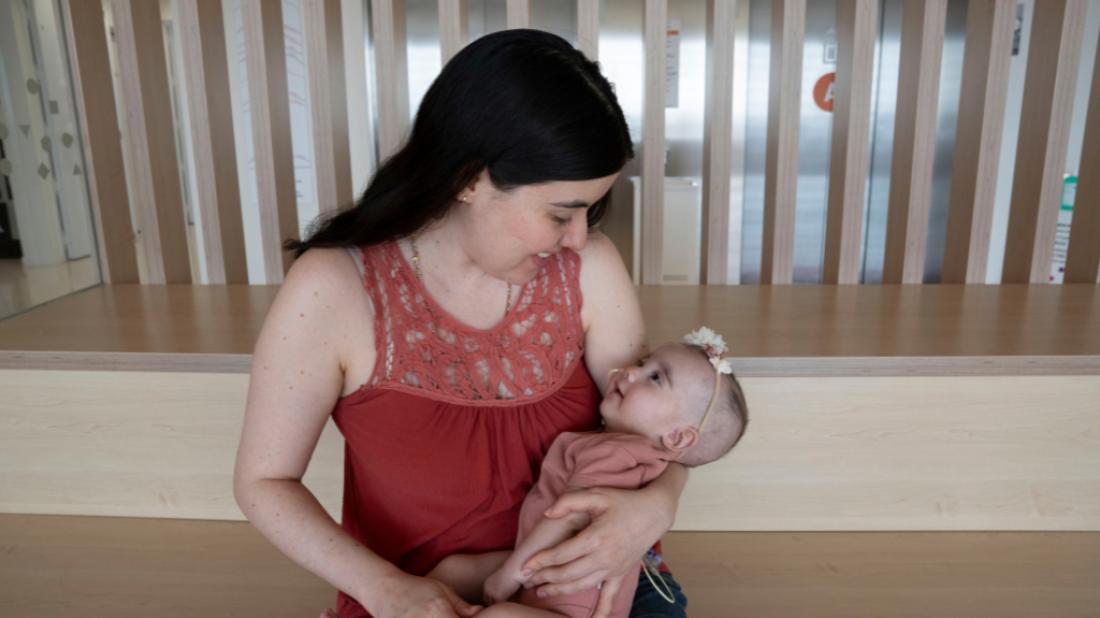
Vanesa travelled to Barcelona whilst pregnant with Lucía to have a diaphragmatic hernia treated, and she highlights the support she received from the hospital staff before, during and after the surgery.
Vanesa recalls that her pregnancy was progressing normally until, during an ultrasound scan in week 16, the doctors detected that her baby had a congenital diaphragmatic hernia – an opening that had not closed completely during foetal development, through which abdominal organs were protruding into the chest cavity. This hernia was affecting the growth of the foetus’s lungs, which were smaller and less mature, and which, at birth, would be unable to function properly. This condition threatened the baby’s survival.
In Colombia, specialists explained that this was a complex case and recommended they seek out a centre with extensive experience in treating diaphragmatic hernias. It was then that a doctor at the Clínica Bolivariana, who had trained at SJD Barcelona Children’s Hospital, recommended they come to the hospital.
“SJD Barcelona’s response was very swift. We arranged a video call with Dr Eduard Gratacós, and he inspired a great deal of confidence in us,” recalls Vanesa. “He analysed my ultrasound scan in detail and clearly explained the severity of the diaphragmatic hernia and the treatment options. Having this information helped us make the decision to come,” she adds.
The family arrived in Barcelona during the 26th week of the pregnancy. “From the very first moment, we felt supported. On our arrival, a Patient Manager showed us round the hospital and answered all the questions we had,” she explains.
The procedure
In the 31st week of pregnancy, Vanesa underwent a procedure using foetal endoscopy. Dr Jordi Prat, a paediatric surgeon at SJD Barcelona, explains what it involved: “Using foetoscopy, we obstructed the foetus’s trachea with a balloon. This obstruction prevents the fluid produced by the lungs from leaving the foetus and causes the lungs to grow and mature more quickly.”
The procedure went well and, a few days later, Vanesa was discharged from hospital. Over the following weeks, she underwent regular ultrasound scans which confirmed that the foetus’s lungs were developing favourably. This led the medical team to remove the balloon at 34 weeks’ gestation.
Lucía was born at 37 weeks’ gestation. Vanesa emphasises that the birth was a very positive experience and is particularly grateful that her husband was able to be with her during the birth of their daughter. “I thought it was lovely that the dad could be there with us, even though it was a caesarean,” she says.
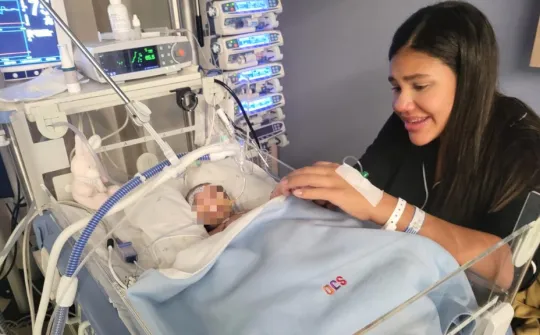
Four days after birth, Lucia underwent surgery to finally have it repositioned the abdominal organs correctly and reconstruct the separation between the thoracic and abdominal cavities using a patch, thereby promoting the proper development of the lungs. Lucía spent 54 days in the Neonatal Intensive Care Unit at SJD Barcelona Children’s Hospital. According to her mother, her respiratory, haemodynamic and cardiac progress was very favourable. The baby experienced some feeding difficulties, such as an allergy to cow’s milk protein and gastro-oesophageal reflux, complications that are relatively common in babies with diaphragmatic hernia.
Once the most critical phase had passed, Lucía spent a few days on the ward before being discharged from hospital. Over the following weeks, the family continued to be monitored through the Sant Joan de Déu a Casa programme. A paediatrician and a nurse carried out daily home visits to monitor her progress, nutritional status and weight gain. Six weeks later, she was discharged, whilst continuing to be monitored by the gastroenterology team.
Lucía is currently making good progress in terms of both her respiratory function and neurodevelopment, and she eats as normal.
Co-ordinated follow-up with Colombia
When Lucía was three months old, the family were able to return to Colombia. Vanesa is particularly grateful for all the support she received from the Patient Manager to ensure they could travel by plane with peace of mind: “As it was a transatlantic flight, the doctors carried out a pre-flight assessment to ensure that Lucía was in the best possible condition to fly, and the hospital lent us the feeding pump,” she explains.
Before returning to Colombia, the hospital team coordinated the transfer of all of Lucía’s clinical information to ensure continuity of care in her home country. There, she will undergo the necessary check-ups in specialities such as pulmonology, cardiology, gastroenterology, nutrition and physiotherapy.
“The experience at SJD Barcelona has been very positive,” concludes Vanesa. She adds: “I’m a nurse and I was impressed by this hospital’s resources and the quality of care. But, above all, what stands out for me is the compassionate care we received. In the most difficult moments, there was always someone willing to listen to us, be there for us and offer us support. They made us feel that we were not alone.”
Related news