Patient portal

The Mauritanian sisters who were born joined at the abdomen are living a normal life in their country two years after being separated
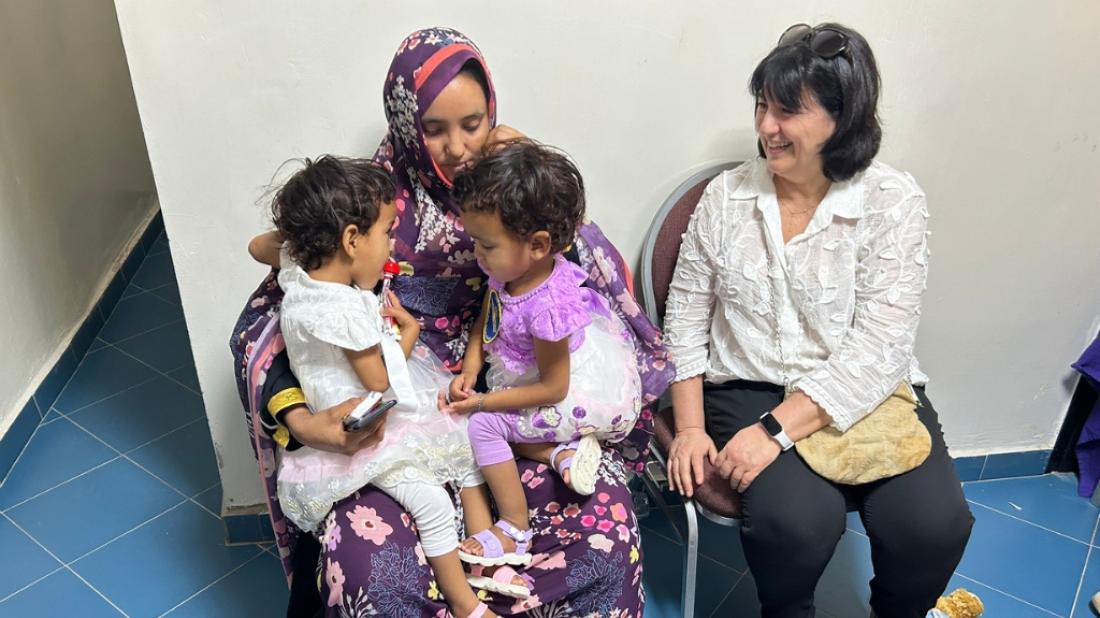
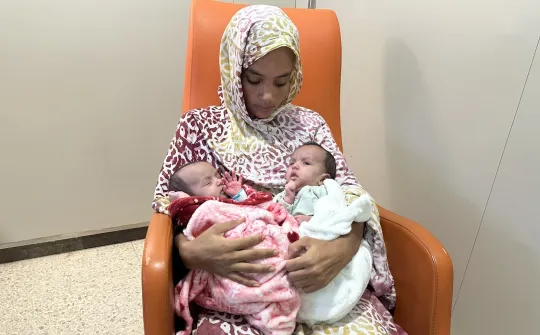
Khadija and Cherive, who are now two years old, were treated thanks to the SJD Barcelona Children's Hospital's international cooperation programme, Cuida'm.
Khadija and Cherive, the Mauritanian twins, who were born in October 2023 joined at the abdomen, are now living a normal life in their country thanks to the surgical separation procedure they underwent. The operation was carried out at the SJD Barcelona Children's Hospital just over two years ago, thanks to the hospital's international cooperation programme, Cuida'm.
A healthcare team from the Catalan hospital, comprising Ana Alarcón, Head of the Neonatology Department, and Patricia Romero, a neonatal nurse, recently visited the girls at the hospital in Nouakchott, the capital of Mauritania.
They are in good health, weighing 10 kilos and only have a scar on their abdomen as a reminder of the surgical procedure carried out two years and four months ago by the SJD Barcelona Children's Hospital surgery team, led by Xavier Tarrado.
According to Ana Alarcón, 'we have been able to assess the girls alongside the team from the Mère et Enfant Hospital in Nouakchott, confirming that they are perfectly healthy, and growing and developing excellently'. She adds: 'both the medical team and the family are very pleased with the girls' progress, and the parents have expressed their profound gratitude for the welcome and treatment they received at the SJD Barcelona Children's Hospital, which made them feel at home despite the distance'.
The Catalan team's visit to the Mauritanian capital also served to evaluate the collaboration programme that the consultancy Additum and SJD Barcelona Children's Hospital maintain with Mauritania's Ministries of Health and Digitalisation. The aim of this partnership is to improve access to the health system for more than 50% of the Mauritanian population by taking advantage of the opportunities offered by digital technology and, in particular, artificial intelligence.
An operation involving more than 20 professionals
The twins were born on 8 October 2023 in Mauritania, joined at the upper abdomen and with a single umbilical cord. Unable to separate them in their home country, Mauritanian health authorities approached the SJD Barcelona Children's Hospital for advice through this international cooperation programme.
A week after the girls were born, the SJD medical team received images sent from Mauritania, concluding that the separation was feasible and could be carried out at the Barcelona hospital. Khadija and Cherive travelled to the SJD Barcelona Children's Hospital and were treated through the hospital's charity programme, Cuida'm.
The patients underwent surgery on 8 November 2023. The operation lasted five hours and involved around twenty professionals. A 3D-printed simulation had been created beforehand to ensure the complex surgical procedure would go off without a hitch. After the operation, Khadija and Cherive were transferred to the Intensive Care Unit, where they quickly recovered and were able to return to their country a few days later.
434 cases treated through the Cuida'm programme
Khadija and Cherive are two of the 434 children treated by the Cuida'm charity programme at the SJD Barcelona Children's Hospital since its inception in 2004. The aim of this initiative is to provide underprivileged children from anywhere in the world a chance to access medical and surgical treatment when they cannot find an alternative medical option in their home country.
The programme relies on a large number of donors who cover the costs of the operations, logistics and upkeep, as well as the support of the Hospital's clinical teams who, donate their time to operate on all these little patients.
Related news