Patient portal

The use of AI in the healthcare sector: SJD Barcelona is committed to ethics, technology and strategy
Our implementation model is based on identifying genuine needs, assessing risks, supporting professionals and ensuring the oversight of artificial intelligence tools.
Artificial intelligence (AI) is making inroads into many aspects of our daily lives and, as in other fields, is also seeking a foothold in the healthcare sector. However, this process is not merely a matter of adopting new technological tools. SJD Barcelona Children's Hospital has opted for an implementation strategy based on governing AI from an ethical perspective and through a ‘learning by doing’ approach: accelerating the learning process regarding the adoption and scalability of these tools whilst they are being used.
Yolima Cossio, Director of Digital Strategy, Data and Information Systems at SJD Barcelona, explains that the first step in this process is to secure the involvement of the entire management team to define what sort of organisation the hospital will be with regard to AI. Once these boundaries have been established, the next step is to begin identifying real needs and assessing whether AI is truly the appropriate solution. “Many of the issues that appeared to require an AI-based solution actually only required an organisational change or a reallocation of roles,” explains Cossio.
This approach is a part of an implementation model based on ethics, technology and strategy, which determines different levels of control depending on the risk associated with each tool. Those used for low-risk tasks, such as administrative processes, can be deployed in protected environments following specific training.
By contrast, algorithms that may influence diagnosis, treatment or clinical decisions require evaluation, innovation and research processes before they can be used with patients. Furthermore, once implemented, all these systems approved by the European Union are subject to ongoing monitoring to ensure they are functioning correctly.
At SJD Barcelona, AI is seen as a support tool, never as a substitute for healthcare professionals and their humanity.
Driving innovation
The hospital has already approved the use of AI tools such as Scribe. This is a system that helps to draft the patient’s medical record based on the consultation conversation. This allows healthcare professionals to interact with patients in a more personalised way, maintaining eye contact without having to type on the computer all the time.
In line with the centre’s implementation model, SJD Barcelona has developed the ‘Learning by Doing’ programme, which enables the hospital’s management teams and healthcare professionals to identify real-world problems in their areas of work that can be addressed with the help of artificial intelligence. Within this framework, 11 projects have been selected, spearheaded by the hospital’s so-called ‘champions’ – professionals who have first-hand knowledge of the needs and challenges in their respective areas.
These proposals have been developed with the support of specialist consultancies, which have contributed their knowledge and technical expertise in AI whilst learning from the professionals’ specific knowledge of each field. The initiative, coordinated by the hospital’s AI Office, thus aims to ensure that technological innovation can be translated into real-world solutions. “The aim is to prevent technological innovation from being confined to pilot projects with no follow-up,” explains Cossio.
Supporting and training professionals
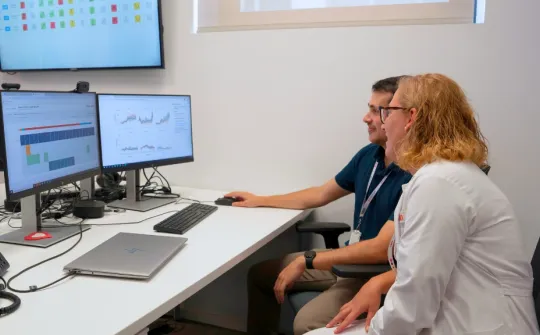
A change of this nature in a working environment such as a paediatric hospital requires comprehensive support for staff. In this regard, SJD Barcelona is committed to providing tools that are secure and approved by the organisation and the EU, training teams and monitoring their use.
“We believe that an organisation committed to innovation must start from reality: our staff are already using ChatGPT and other artificial intelligence tools,” admits Cossio. For this reason, the director argues that “our response cannot be to ignore this use or to restrict it indiscriminately, but rather to provide a clear framework so that they can use these tools safely, responsibly and in line with the institution’s values. In this regard, we support them as they discover new tools and ways of using them, as these technologies are advancing rapidly.”
Ethics in AI
SJD Barcelona Children's Hospital considers it essential to incorporate clinical, technical, ethical, legal and human perspectives into decision-making regarding artificial intelligence. To this end, the hospital has a multidisciplinary governance structure that enables it to assess not only the risks, but also the relevance, value and conditions under which each solution should be implemented. This approach is particularly important when AI can directly influence patient care, for example in diagnostic or treatment processes.
Faced with this highly technological landscape, Cossio highlights another challenge: preventing the loss of human capabilities. It is crucial that healthcare organisations define which processes can be delegated to AI and which must continue to rely on the judgement and skills of healthcare professionals. In this regard, AI is envisaged as a support tool, never as a substitute for the professional.
Patients’ perspectives must also form part of this transformation. SJD Barcelona already has projects in which the functioning of the tools is validated with patients in order to design the best solutions for everyone.
For Yolima Cossio, the challenge is not to incorporate AI into all the hospital’s processes, but to do so where there is a proven benefit and with the necessary safeguards. The technology must make it possible to reduce tasks that do not add value, so that healthcare professionals can devote more time to what requires their knowledge, their decision-making skills and their relationship with the patient.
‘High Tech & Human Touch’ Conference
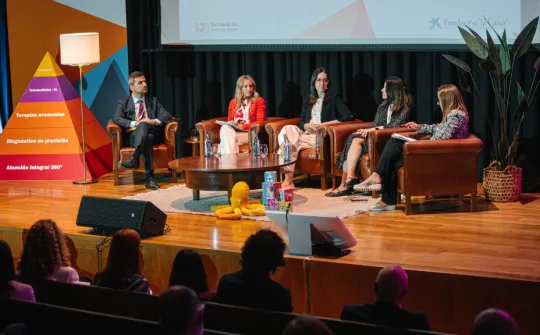
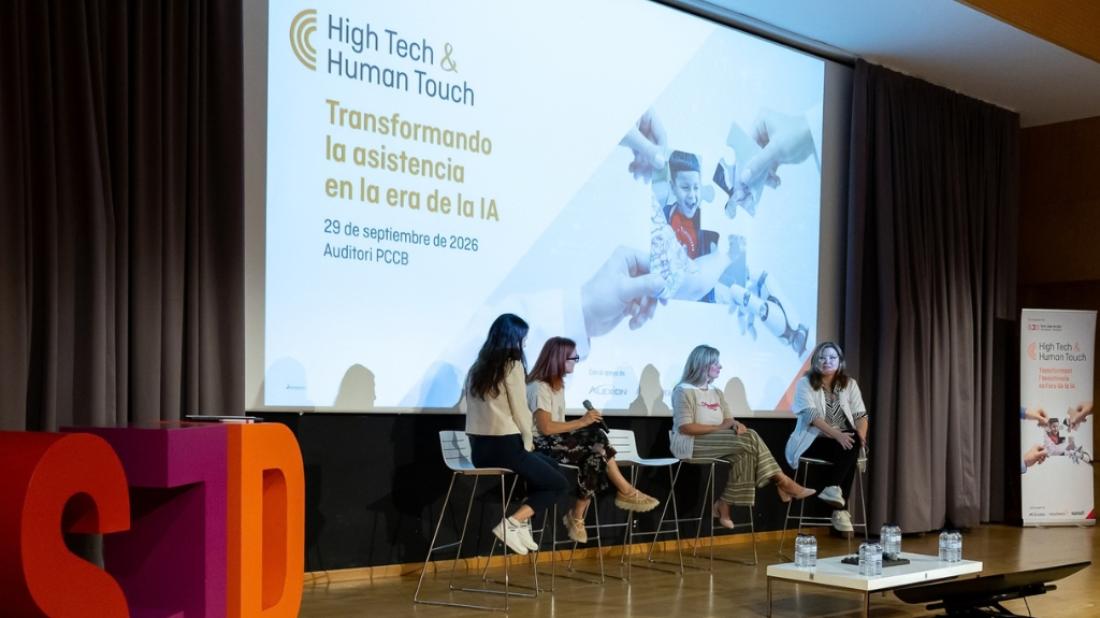
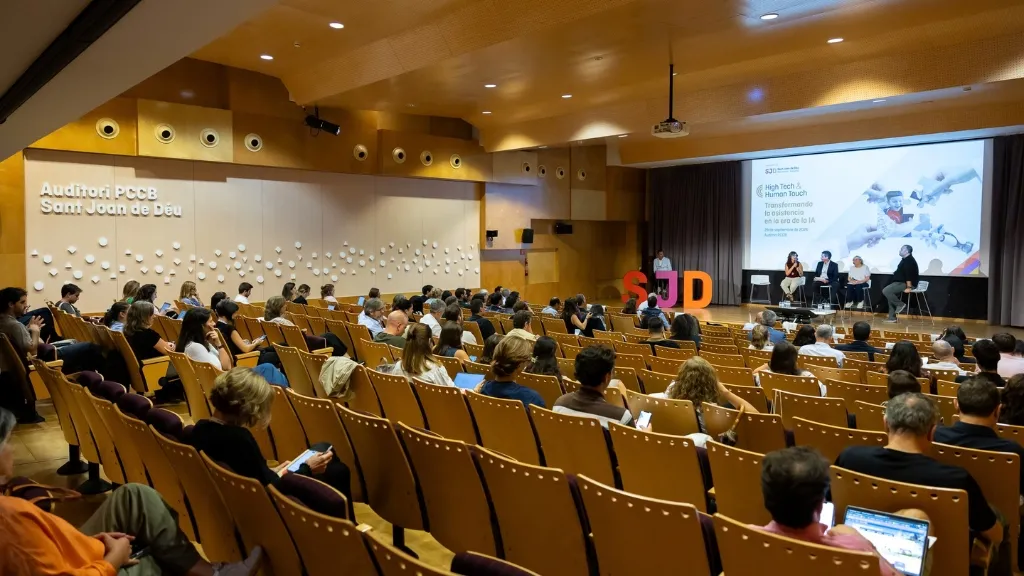
Beyond the policies of SJD Barcelona, the implementation of AI in the healthcare system must be tackled collectively, involving all experts and organisations in the sector. To this end, the Hospital has organised the “High Tech & Human Touch” conference, a forum that has brought together hospitals, public authorities and technology companies to share lessons learnt, tackle common challenges and reflect jointly on decisions that no single organisation can tackle alone.
Through a series of panel discussions featuring experts in the field, participants discussed the regulation of AI, its economic sustainability and its integration into healthcare processes, amongst other issues. Yolima Cossio described the event as a starting point for the integration and development of these tools in healthcare. “At present, there are many gaps, but now is the time to start considering how we move forward. And there is still a long way to go,” she concluded.
Pol Pérez, Director of ICT for the Catalan Health System, brought the event to a close by summarising, based on the discussions, the three major challenges still facing the implementation of AI in healthcare. Firstly, Pérez pointed out that standardised and well-governed data must be guaranteed across all centres, enabling information to be shared and solutions to be scaled up. Secondly, he considers it essential to integrate AI into the care process so that it provides real value to professionals and patients. And finally, he noted that development must be economically sustainable and comply with regulatory requirements. “These would be the keys to moving forward and making progress together,” said Pérez.
Related news